Made for exactly two
Six puzzle games for exactly two people.
Most lists of two player puzzle games send you to a console or an app store. These six live at one address, in your browser. You pick a game and a piece count, one link goes to your person, and the second chair is theirs, whether that is across the sofa or across an ocean. Voice and chat already sit at the table. Nothing to install, nothing to pay, and every table seats exactly two.
free · no sign-up · in your browser · exactly two seats
The short answer
What are some puzzle games for two players?
Six browser games, free and with no sign-up: a classic co-op jigsaw on one shared board, Half & Half, where each player owns half the pieces, Monopole, where the pieces attract and repel each other, Guide & Builder, where one of you sees the picture and the other builds it blind, Battle, a race on identical cuts, and Impossible, where several paintings share one table and every join you make re-deals it.
All six are online in the ordinary way, a page the two of you open rather than a program you install. Being honest about the shape of it: these are all jigsaws underneath, six different sets of rules laid over the same pieces, not six different genres. One more table, the Switching Puzzle, waits for the nights when your calm could use some trouble.
The six, plus a stray
Six games, one table for two.
The pieces and the table behave the same in all of them. What each game changes are the mechanics of seeing and touching: who holds the picture, who may move which piece, and whether anyone is racing.
| Game | Pieces | Shape of it |
|---|---|---|
| Classic co-op | 25 to 2,000 | One shared board, built together |
| Half & Half | up to 300, always even | Co-op with a rule: you own half each |
| Monopole | 25 to 600 | Co-op, with charges that pull and push |
| Guide & Builder | up to 48 | One talks, one builds blind |
| Battle | 150, or 100 with ghosts | A race on two separate boards |
| Impossible | 24, 54 or 96 | Co-op, and every join re-deals the table |
| Switching Puzzle | up to 100 | Co-op, and the picture keeps changing |
The classic co-op jigsaw
One shared multiplayer board: the same pieces, in the same places, moving live for both of you as they snap into groups. The only thing that is not shared is the image printed on them. Each of you picks your own, a painting from the museum gallery or a photo from your own phone, and a photo you upload is cut up in your browser and never sent anywhere. So the cut is identical, the work is joint, and the picture underneath can still be yours. From 25 up to 2,000 pieces. A busy picture is easy and a flat one is hard, which means the challenge lives in what you choose, and mismatched puzzlers can share one big board without anyone pretending.
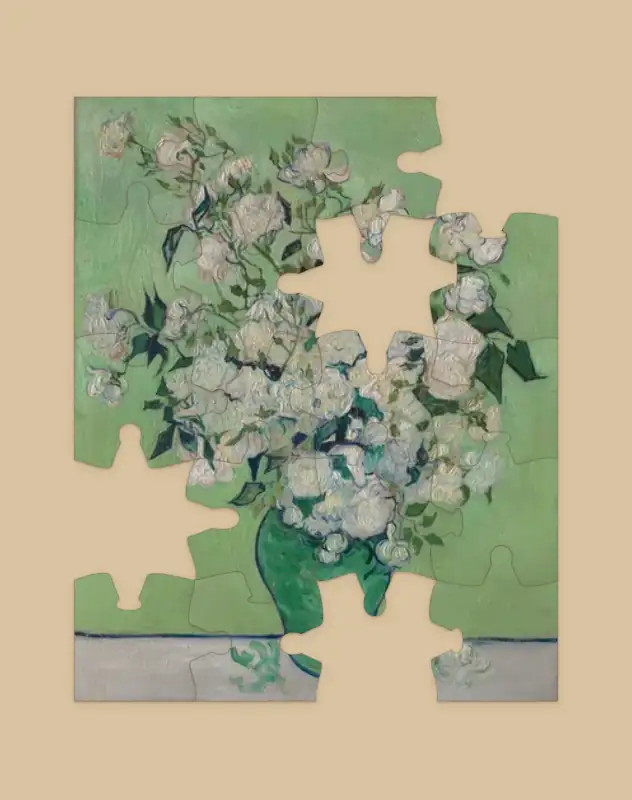
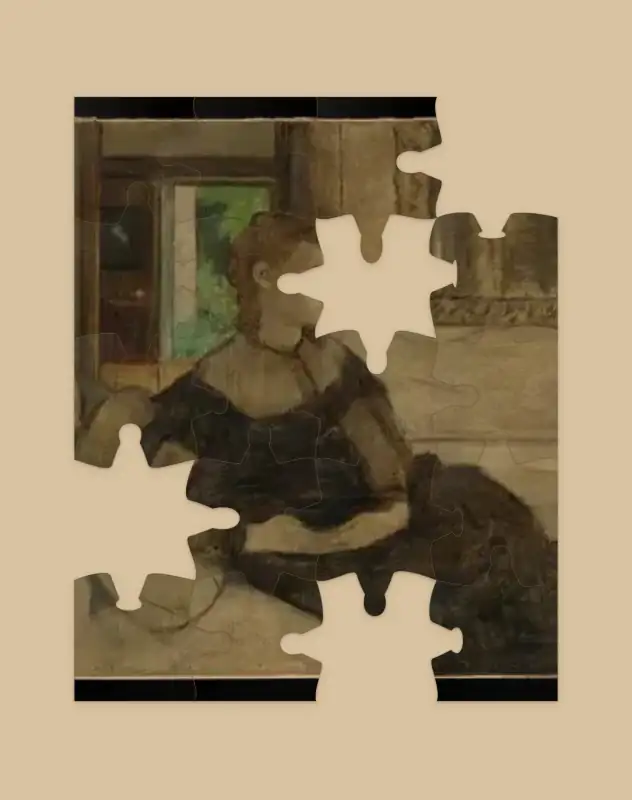
same cut for both of you. your own picture on your own table.
Half & Half
Every piece belongs to one of you, half and half, and at first you only see and move your own. The mat in the middle is the meeting point. A group turns shared the moment you drop it on the mat, and it is the mat that does it rather than any button you press: from then on you both work together on that group, and it never goes private again. That is the hand-over you would make across a real life table, surviving the distance, and it means the picture cannot finish unless both halves keep arriving. Even piece counts only, up to 300, so the halves stay equal and the mat gets filled from both sides.
Monopole
A magnetic jigsaw. Every loose piece carries a charge, positive, negative or neutral, and the rule is the one two magnets taught you: opposites pull together and cancel each other out, and two of the same shove apart and will not join at all. Only pieces that are neighbours in the finished picture ever react, so the table is not a soup of forces. It is the same jigsaw with an argument in it. A five step slider sets how the charges are dealt, from every charged piece having its opposite lying right beside it, up to a deal where the neutral rest has all but gone and the only neutral pieces are the ones the two of you made. Both screens agree the charges rather than each guessing locally, so a block that shoves off from one of you shoves off from the other, the same distance, the same way. 25 to 600 pieces, and you each bring your own picture. Monopole has a page of its own here.
Guide & Builder
The table deals one painting from the gallery to the guide, who sees it whole and cannot touch a single piece. The other of you holds the pieces, plain cardboard with nothing printed on them, and builds from what they hear. The guide gets two clues and no more: mark one piece by its number, or point at a spot on the picture through a three by three grid laid over it, top left through bottom right, one clue at a time. Everything else has to be said out loud. Rounds stay small, up to 48 pieces, and a swap deals a new painting so you can trade chairs. More on this one below.
Battle
The one table with a winner. Same picture, same cut, two separate boards, and every piece stays hidden until you have both pressed ready, so nobody starts early. First finished wins. Up to 150 pieces, or 100 if you turn on ghost pieces, which show you faintly where your opponent is working and are either reassuring or terrible for your nerves, especially near the end. If a race is the whole point of your evening, speed puzzling has a page of its own here.
Impossible
The hardest table here, and the newest. Up to twenty paintings are cut into one board, every cluster belongs to one of them, and two clusters lock together only when they came from the same painting. So the first job is reading rather than fitting. Then the part that makes it what it is: every join either of you makes deals the whole table again, for both of you at once, and whatever your partner had just worked out about the rest of it is undone in that moment. The pool shrinks as you go, one painting leaving at a time, until a single one is left whole in front of you both. A slider sets how alike the paintings are, and at the top of it you get a set by one painter in one manner, which is as hard as this gets. 24, 54 or 96 pieces, and the piece count is the least of it. Impossible has a page of its own here.
And a stray, for the brave
In the Switching Puzzle the picture will not hold still for you. Ten paintings share one cut, and every join you make swaps the whole picture for the next of them. Failed drops change nothing, only true joins count, so the table moves exactly as fast as the two of you do. A steady button holds the current painting for up to five seconds when you need to look properly. It is capped at 100 pieces, because at that size the picture turns over often enough to keep you laughing and rarely enough to still be solvable.
No console needed
Co-op puzzle games, no console required.
If co-op puzzle games means It Takes Two or Portal 2 to you, those are great games, and they are another animal altogether: puzzle video games, titles that live on Steam, a PS4 or PS5, an Xbox or a Switch, cost money, and expect a controller. That is what a best co-op puzzle games list is usually made of. This page is the other answer.
The games here run in the browser, making no demand beyond what the two of you already own. An Android phone in one country, an iPhone or a tired laptop in the other, and the table neither knows nor cares. No download, no gaming PC, and free. And if you were looking for 2 player puzzle board games, cardboard on an actual table is its own pleasure we will not pretend to replace. This is the nearest a browser comes: one table, two chairs, pieces going where they belong while somebody you like watches from their own screen.
One sees, one builds
Games like Keep Talking and Nobody Explodes, without the bomb.
There is a small family of games where one of you sees what the other cannot, and the entire game happens in the talking. Keep Talking and Nobody Explodes is the loud, famous one, a bomb, a manual, a shouting friend. Two player escape room games touch the same nerve, two people holding two halves of one answer. Guide & Builder is that idea gone quiet. The same elements, hidden information and talk, with a painting in place of a bomb, no timer anywhere, and no logic manual to learn.
Escape rooms sell the feeling of finishing together against the odds. Here you solve the table by describing it. Putting a cloudy Dutch sky into words for someone who cannot see it comes down to naming colours, agreeing what to call the shapes, and saying where things sit, which is most of what any communication game is really drilling. When the last piece lands, one of you held the picture and one of you laid the pieces, and it took both.
How it works
How a table starts.
first
Pick the game
Classic, Half & Half, Monopole, Guide & Builder, Battle, Impossible, or the Switching Puzzle, then set a piece count with the slider.
then
Send one link
It carries the whole setup. They tap it, take the second seat, and you are on. No account required on either end.
and
Play, and talk
Voice and chat live in the room, or keep your usual video call running beside it, no extra app needed. Step away mid-game and the lobby will save your open table, so you can check back in tomorrow.
Pick tonight’s game
Which one tonight?
A slow evening
The classic board, set generous. The talk wanders, the pieces snap, nobody keeps score.
Proper teamwork
Half & Half if you want the table to force generosity. Guide & Builder if you want it to force listening.
A score to settle
Battle, best of three. Loser picks the next game.
Something to beat you
Impossible, twenty paintings, the slider high. Finishing it at all is the achievement.
Questions
Asked before you sit down.
What games can we play in 2 players?
Six here are made for playing together: the classic co-op jigsaw, Half & Half, Monopole, Guide & Builder, Battle and Impossible, with the Switching Puzzle as a seventh table for a rowdier night. Each runs in the browser from one shared link, so you are never the odd pair waiting in a party lobby built for eight.
What are some fun free 2 player games?
All of these are free, with no account and no paywall. Which one is fun depends on the night: the classic board is calm, Half & Half asks you to be generous, Guide & Builder gets loud, Battle settles an argument. Open a table, send the link, and you are playing within a minute.
What are good 2 player co-op games?
On a console or Steam, the famous answer is It Takes Two, a co-op adventure built for friends on a couch. In a browser, a co-op jigsaw is the calm one: a single board you both build, or Half & Half when you want teamwork with a rule in it. Impossible is the same idea with the calm taken out, a table that re-deals itself every time either of you gets something right. Gentler than an online escape room, unless you pick that last one, and you still talk the whole time. Any device on each end.
What are good games for 2 adults?
Quiet games with real conversation in them age best. An evening spent solving a shared painting, or a Guide & Builder round where one of you has to put a Rembrandt into words. Nothing childish to sit through, and no puzzle experience needed to enjoy the small boards.
How many people can play?
Exactly two. Every table has two seats and never a third, by design rather than by accident. There is no 4 player lobby here, and no crowd to lose each other in.
Does it work on a phone?
Yes. A mobile browser is all it needs, Android or iOS, with no app store in between. A phone and a laptop make a fine pair. Piece counts are capped per mode by what the mode is for rather than by your device, which is why the classic board goes to 2,000 while a Battle tops out at 150: a race wants a count the two of you can finish in one sitting. Impossible is the one exception, and only for how many paintings it will put on the table at once, where a smaller device is held to ten.
Is there a PS4, PS5, Xbox or Switch version?
No console version, and no iOS or Android app either, because none is needed. Every table here is a web page: the mobile browser you already have, or any laptop, is the whole requirement. Two people, two devices of any kind, one link.
Do we have to be in the same place?
No. These games were made for two people in two different places, and the link does all the traveling between you and your friend, across a town or across the world. Voice and chat are built in, and your usual call app is welcome to run alongside. The tables require nothing else.
Can anyone cheat in Battle?
Not by peeking. In a plain Battle your browser is only ever sent the other side’s progress, never where their pieces sit, so there is nothing to find however hard you poke at the page. If you turned on ghost pieces, seeing each other’s boards faintly is the point, and it works both ways. The race also opens for both of you in the same moment, once you have both pressed ready.
What if one of us is much better at puzzles?
On the classic board the picture sets the difficulty, busy is easy and flat is hard, so unequal skills can share one cut fairly. In Guide & Builder, hand the stronger puzzler the picture and tie their hands. In Half & Half, the mat evens things out piece by piece.
What if we are a group of friends rather than a pair?
Then this is the wrong table, and that is worth saying plainly. Two seats is the whole design here, and every table in the Connected by family is being built the same way. For a group, pair off and run a bracket: two tables at once, the winners meet, and the whole thing fills an evening.