A puzzle that will not hold still
Hard jigsaw puzzles, online.
There is nothing like holding a jigsaw piece and sliding it into place, and no screen has ever reproduced that. So this puzzle does not try. It is built from the one thing a digital table can do that a boxed one cannot, which is change while you work. Impossible cuts up to twenty paintings into a single table, asks you to work out which fragments belong together, and deals everything again the moment you join a pair. It plays in a browser, it is free, and you can work the table alone or open the same one to a second person.
free · no sign-up · nothing to download · 24, 54 or 96 pieces · one or two of you
Why it needs a screen
A hard puzzle no box could hold.
A printed puzzle is a fixed object. Each piece is cut once, printed once, and waits in the box carrying the same fragment of the same picture for as long as the puzzle exists. The hard ones sold to adults are hard inside that limit, so they make the fragments unreadable: a single flat colour, a repeating pattern, five thousand pieces of sky. That works, but it is one kind of work. A piece, once read, stays read, and most of what remains is sorting.
On this table nothing is printed. What a cluster shows is assigned by a deal, the way a hand of cards is, and the table can hand out a new deal whenever the rules call for one. The table also decides what is allowed to lock: two clusters join only when their fragments came from the same painting, which no die-cut can enforce when every piece comes off the same board. And it can take paintings away while you work, which a box can only manage by losing pieces. None of that is available to cardboard at any price.
Does that make it better? Not necessarily. Paper wins at being paper, and this page will not argue with the feel of a real piece under your hand. What the screen buys is a different kind of difficulty, where the solving is reading rather than sorting and the work stays mental rather than mechanical, so a table of ninety-six pieces can be a real problem while a thousand-piece box is mostly patience. The piece count is the least important choice you make here.
How Impossible works
Several paintings, one table, one survivor.
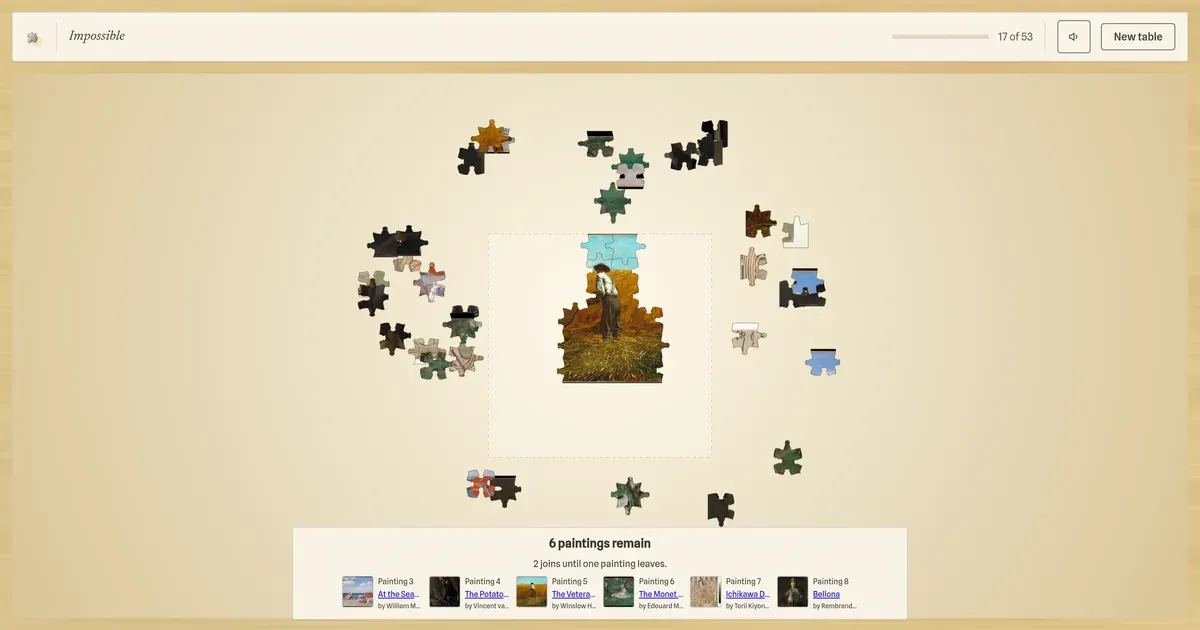
Impossible deals two or more paintings onto the same board, at twenty-four, fifty-four or ninety-six pieces. Each cluster on the table belongs to one of them, and the first job is deciding which. Two clusters lock together only when they came from the same painting, so before you can make a move you have to read a fragment and place it.
Find a true pair and the entire table is dealt again. Nothing moves. Each cluster stays where you left it, at the size and the angle it already had, and what changes is what each one is showing: a new painting, and a new part of that painting. The pair you just made is the only thing you keep. Everything you had worked out about the rest of the table is now wrong.
There is always something to find. Each deal reserves one true pair for every painting still on the table, and one of those pairs always involves the cluster your last join made, so the table you are handed after a re-deal is never a dead end.
The pool shrinks as you work. A line under the board counts down, three joins until one painting leaves, then two, then one, and when it reaches zero a painting is removed for good and named on its way out. Which one goes is not random. The game keeps the paintings you have been building on and drops the one whose largest cluster is smallest, and the painting you have just joined is safe for that round. Near the end it tells you outright: the painting you join next becomes the survivor.
It finishes with one painting left, whole, in front of you. That is the whole of the ending. Nothing unlocks behind it.
The settings
Three choices, and what each does.
Paintings is how many are on the table at the first deal. It begins at two, and the ceiling depends on the size you chose, because a table seats one painting for every four pieces up to a limit of twenty. Twenty-four pieces takes six, fifty-four takes thirteen, and ninety-six takes the full twenty. Smaller devices are held to ten, and the setup says so when you are on one.
Resemblance decides how alike those paintings are, in five stops, and the labels are the honest description of each: Nothing alike, Barely alike, A family resemblance, Hard to tell apart, and Cruel, do not start here. At the bottom the table chooses works that look as unlike each other as the collection allows. Above the middle stop it stops spreading them out by artist and by style, so the top of the slider can hand you a set by one hand in one manner, which is the hardest table there is.
Let pieces tumble starts each cluster at a random quarter turn. Two clusters interlock only once they face the same way, so a pair you have already spotted can still refuse to read as one, and the picture has to end upright. Right-click or double-tap a cluster to turn it.
Two of you
The same table, in two places.
Impossible seats two, and the two of you do not need to be in the same room or the same country. One of you sets the table on the room page, with the same settings as above, and gets a link to send. The other opens it and sits down. Nothing to install on either side, and nobody makes an account.
The table opens once you both have the pictures. Until then it says so and waits, and you can see whether the other person has arrived yet.
Then it is one table, not two boards side by side. Every join either of you makes deals the whole table again, for both of you at once, so the reading the other person had just finished doing is undone in the same moment your pair locks. Two people around a boxed puzzle are still two people around one fixed picture. Here you are both changing it, which does not make it gentler for being shared. It makes it harder, because now there are two of you moving the ground.
There is a chat panel in the room the whole time, and voice if the person setting the table switches it on. Both are worth having. What you are working out here is which painting a fragment came from, and that is a thing more easily said than pointed at.
The room holds its place for two days, so a table you leave half done is still there tomorrow, for whichever of you opens it first.
Losing, if you want it
The one thing you can fall short of.
Left alone, Impossible cannot be failed. No timer runs out, there is no move limit, and no deal can reach a state that cannot be finished. Keep going and you finish. So the losing is opt in, through a setup switch marked Score the rounds, which is off until you reach for it. It belongs to the solo setup. A table for two keeps no score.
A round is the stretch between one successful join and the next. It opens with ten points for every painting still on the table and counts down a point a second, so a round is worth what is left on it when you bank it, and a round you take longer over than its budget is worth nothing at all. Because the budget follows the live pool, the rounds shrink as paintings leave: a twenty painting table opens at two hundred points, and its final round, with one painting left, is worth ten.
One painting each round is tagged Double points on the pool strip, and a join on that one doubles whatever survived the countdown, which means doubling nothing is still nothing. A tumbled table doubles the whole budget, because turning widens the search rather than adding a step to it.
At the end you get a total, and a line telling you how many of your joins landed on the marked painting. There is no leaderboard and nothing to sign into. Your own browser works the number out, and no server is ever told it.
When your hours never line up
Send the table, not the answer.
A score on its own is a number in an empty room. What it wants is a second person, and that is what the finish screen is for. It has a button marked Share your score, which opens the site's own sharing sheet rather than the phone's, and it asks first whether this is going to one person or to everyone. WhatsApp, Telegram, a text message and email come first. Posting it to everyone sits underneath, and your own phone's sheet is offered last, where there is one.
The link carries the piece count, the number of paintings, the resemblance stop, whether the table tumbled, and your score. It does not carry the deal, and that is left out on purpose. Same difficulty, not the same table. Send the deal as well and the person you sent it to is memorising your run instead of playing their own.
Whoever opens it lands on the setup arranged that way, with the scoring already switched on, under a line saying someone scored that many points here. Each control is still live. If they pull the resemblance down or drop to twenty-four pieces, the banner stops claiming a match and says why, because the two numbers no longer compare. While they play, a small chip reads to beat, and the number. At the end it either says they beat your score, or that your score still stands. They can take the challenge whenever they like, which is the whole point of it.
Questions
Before you start.
Are there any hard jigsaw puzzles available to play online, with no download?
This one is, and it needs no download. Choose a size, press the button, and you are in a table: no app to install, no account to make, and no setting held behind progress, so the hardest table is available on the first one you ever deal. There is no daily puzzle to wait for either. Deal a new one every day, or once a year.
What is the most difficult jigsaw puzzle in the world?
That question is about a physical object, and the usual answers are the famous ones: a puzzle cut from a single flat colour, a five thousand piece wooden panel, a die-cut where no two pieces repeat. Those are things you buy, and once the box is open they behave. This one is hard in a way a printed object cannot be, because the picture is allowed to change while you work.
How hard can it get?
More challenging than the piece count suggests. Ninety-six pieces is a modest board by boxed standards, but the difficulty here scales with the paintings on the table and how alike they are, not with the count. The hardest table you can set is ninety-six pieces, twenty paintings, the top resemblance stop, with tumbling switched on.
Can I play it with someone else?
Yes. Impossible seats two, and it is one table rather than two boards side by side, so a join by either of you lands on the puzzle in front of both. The section on playing it together says what a second person changes. If your hours never line up, the score link is the other way to bring someone in.
Do we take turns, or work at the same time?
At the same time. There is no turn order and nothing waits for anyone. You each hold one cluster at a time, and a cluster the other person is holding will not lift for you, so the only thing you can take from each other is the pair you were both about to make.
Can I stop in the middle and come back?
Yes. The table saves its place as you go, on the device you are playing on, so you can close the tab and open the same one another day. There is room to save one solo table at a time. The menu shows it as a card, and asks you to continue it or discard it before you deal another. A table for two is not kept that way: the room holds it instead of your browser, and the section on playing together says for how long.
Where do the paintings come from?
The Met, all public domain, out of the same reviewed collection of art the rest of the site draws on, and chosen by the table rather than by you. It is a wide gallery: landscapes and portraits, still life, studies from nature, animals, weather and quiet rooms. That range is what gives the resemblance setting something to work with. It is also the one thing this mode gives up, because you cannot bring your own photo to a puzzle whose whole question is which painting you are looking at.
If you wanted the other kind
The classic table stays put.
Some evenings the right puzzle is the plain one, and it is here too. The classic table cuts a jigsaw out of whatever you give it, a painting from the gallery or a photo of your own, anywhere from twenty-five to two thousand pieces, and the picture never moves. It seats two as well.