One player, one tab, no deck required
Solo card games, online.
Have you ever tried playing patience with something other than cards? Most people have not. We did, and it turns the game into something else entirely. This is a list of card games for one player that run in a browser, including two of our own where the cards are pieces of paintings and prints.
free · no sign-up · plays in the browser · saved on your own device
What card games can you play alone?
Solitaire is the famous one, but the canon is wider: Accordion, Pyramid, Clock, Beehive and Spider all deal from a single player's hands. Online you can also play card games no physical deck supports, such as patience dealt from a jigsaw, where pieces match by picture instead of by rank.
The one that started this
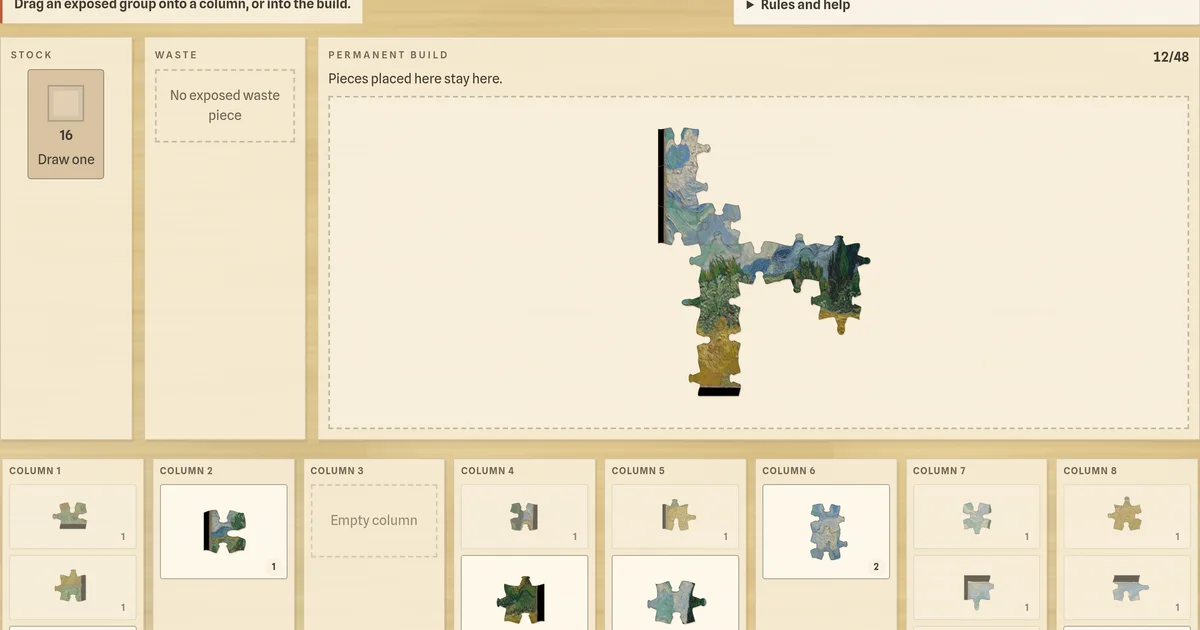
Patience, dealt from a jigsaw.
Take an ordinary patience game and swap the deck for the pieces of a picture. It sounds like a novelty. It is not, and the reason is worth a minute.
In Klondike, a black eight takes a red seven, and either red seven will do. The rule is a symbol you read, and how the deal falls decides a great deal of the game. Here the rule is a fact about one particular painting: these two pieces were neighbours before the cut, or they were not. A piece from the middle of the picture has four pieces in the whole deck it can join. A piece from a corner has two, and nothing else will do, because there are no substitutes and no second red seven. Corner contact does not count either.
That one change moves the game out of your memory and into your eyes. You are not tracking which cards have gone. You are looking at a scrap of brushwork and deciding whether it continues into the piece below it. A busy picture is generous. A flat sky is not, and choosing the picture is as much your difficulty setting as the piece count is.
Three tables, and one can be lost
On the calm ruleset, groups fuse where they meet, a column never gets deeper, and sensible play comes out every single time. On Forty Thieves, what you put down covers what was under it, and roughly one deal in five comes out at forty pieces. We measured that.
Forty to a hundred pieces
On a slider before you deal. Hundreds of public-domain paintings and prints from The Met to choose between, or a photo of your own if you would rather play somewhere you have been. The picture never leaves your device.
Guessing costs nothing
Put a group where it does not belong and it will not settle. The column gives a shake, the piece comes back to you, and the table is exactly as it was. There is no penalty and no move counter to protect.
If you have met a jigsaw solitaire before, the odds are it was not really one. The games carrying that name deal square cards with slices of a photo and have you slide, swap and merge them, which is a matching game wearing a patience name. The structure underneath is the part that matters, and this one keeps it: eight columns, a stock that turns once and never deals again, a build that is permanent, and a legal move that depends on the picture rather than on a symbol. We went looking for a version that did that before building ours and did not find one, which still surprises us.
Nobody asked for this one
Then we tried it on rummy.
Solitaire worked well enough that we wondered which other card game would take the same treatment. The next donor of mechanics was gin rummy.
Substitute the pieces for the cards and you get a game that is like gin rummy and still is not. A gallery of small pictures is cut up and dealt. Your hand holds fragments of several of them. A meld is three or more pieces that genuinely sit edge to edge in one artwork, so instead of reading rank and suit you are deciding whether two pieces were neighbours before the cut. Draw one, let one go, exactly as you would at a rummy table.
You play it alone, against one to three computer opponents, and three rulesets decide how an artwork is won.
Open gallery
Melds go down face up for everyone. Whoever places an artwork's last piece hangs it on their wall, and most artworks wins. You can grow anyone's meld on your turn, which pays you pieces back from the river.
Showdown
Hands stay hidden until somebody knocks. Then every artwork on the table goes to whoever revealed more of it, which makes holding a nearly finished artwork back a real decision.
Points
The classic scoring race, with undercuts, gin and a bonus for assembling a whole artwork on your own. First to fifty.
The computer opponents are where this one starts. We intend to open it up to four people around one room later, which would make it the first of our tables to seat more than two.
The part the other lists leave out
Playing solo card games online, and why it is not the same.
Every other list of one-player card games assumes a deck in your hands and a table to spread it on. That assumption is worth examining.
A physical deck asks for a surface, decent light, and the discipline to leave a half-finished game where it lies. A browser asks for none of that. The table is kept for you, so a game you abandon at a bus stop is standing where you left it when you open the tab that evening. Nothing is dealt from a shuffle you have to take on trust, because you can see the cut for yourself.
It also changes what a card can be. A deck has fifty-two cards and four suits, and every solo game ever invented has had to work inside those numbers. Online, a card can be a fragment of a picture, and matching can mean something other than rank and suit. That is the whole reason the two games above exist.
What you give up is the feel of the cards. We are not going to pretend otherwise. If what you want is the shuffle and the snap of a real deck, close this tab and go and find one. If what you want is a game to fall into for twenty minutes without setting anything up, both of ours are open.
If you came with a deck in your hand
The classics people mean by solo card games.
These are the games worth knowing. We do not host them. They are older than all of us and they need nothing but a pack of cards.
Accordion
Deal cards in a row. A card may move onto the one immediately to its left, or the one three to its left, when it matches suit or rank. You are trying to collapse the whole row into a single pile, and you almost never will. The best five-minute game in the canon.
Pyramid
Twenty-eight cards in a pyramid, and you remove pairs adding up to thirteen. Simple to teach, and it turns on which cards you free early.
Clock
Thirteen piles laid out like a clock face. You turn a card and put it at its own hour, then turn the next. It rather plays itself, and you lose if the fourth king appears before you finish. A game of watching instead of deciding, and oddly calming for it.
Beehive
A ten-card hive and a small garden of cards, worked through the pack to gather four of a kind. Fiddly to set up, satisfying to clear.
Spider
Two decks, ten columns, eight suits to build in order and clear. The long one. Set aside an evening.
Classic solitaire, the one that shipped with every computer for twenty years, is called Klondike, in case you have been looking for the name.
The real reason people search this
Card games like solitaire, when solitaire goes stale.
People rarely search for one-player card games because they have never heard of solitaire. It is usually because they have played it into the ground.
If that is you, the useful question is what specifically wore out. If it was the lack of stakes, take the Forty Thieves ruleset, where a table genuinely can close on you. If it was that the moves felt automatic, the jigsaw cut puts the decision back in your eyes. If it was playing alone, Jig Rummy puts three opponents across the table who will take the piece you wanted.
Questions
Before you deal.
What card games can you play alone?
Solitaire in its many forms, and a wider canon that includes Accordion, Pyramid, Clock, Beehive and Spider. Online the list gets stranger, because a card no longer has to be one of fifty-two. Ours are pieces of paintings and prints, played as patience or as rummy.
What is a fun game to play alone?
It depends what you want from the next twenty minutes. For something calm, take a patience game where the table only opens up as you play. For an opponent to beat, take a rummy variant against computer players. For something genuinely difficult, take a ruleset that can be lost.
What are some good card games to play one-on-one?
Gin rummy is the classic two-player card game, and cribbage and piquet are the other two people name. Jig Rummy is our take on the first of those, though for now it seats you against computer opponents rather than another person.
What can I do with a deck of cards alone?
Beyond the games above, a deck is good for practising shuffles, building a house of cards, and the old memory drills. If you have no deck to hand, that is rather the point of playing in a browser.
What is the best card game for playing with only one person?
For one player, Klondike is the default for a reason and Accordion is the best short one. If you would like the same shape with something new to look at, try either of ours.
What card game do they play in solo?
Solo is also the name of a specific trick-taking game, a relative of Ombre, played by three or four people. The phrase confuses search results, so if you came looking for that one, you want a trick-taking game rather than a patience game.
Do I need to download anything?
No. These are web pages. They open on a phone, a tablet or a laptop, there is nothing to install and nothing to update, and your table is saved on your own device as you play.
Can I play these with someone else?
Not the solitaire, which is yours alone the way a patience game is. Jig Rummy seats computer opponents today and we intend to open it to four people in one room later. The rest of the site was built for two people who are not in the same room.
When you would rather not
Everything else here seats two.
The same pictures, the same cut, one shared table, and two people who are not in the same room. If tonight is a solo night, deal one of the tables above. If it is not, there is a seat for someone else.