The Pieces · one painting a day
A daily puzzle game, cut from a painting.
Every day there is one painting, cut into a hundred squares. Five of its pieces are hidden among ten decoys, and a small map shows where the five belong. You have four checks in all to put them back, and each check marks all five slots at once. Free, no sign-up, and nothing to install.
free · no sign-up · plays in the browser · a new painting at midnight UTC
The short version
One painting, five pieces, four checks.
If you play Wordle, you already know the rhythm: one puzzle a day, the same for everyone, a few tries and a row of coloured marks after each. The Pieces keeps that rhythm and swaps the word for a painting: an art Wordle, if you like. Instead of guessing letters you are reading fragments of a picture you cannot see yet, and working out where each one was cut from.
Most daily puzzles are made of words or numbers: the crossword, a sudoku, a five-letter word game. This one is visual, a daily logic puzzle you solve with your eyes as much as with reasoning.
The same for everyone
One painting, the same five slots and the same ten decoys for everybody on the same day. A new one arrives at midnight UTC, so a result you send tonight is one your friend can try too.
Four checks
Each check marks all five slots at once, and four is the day’s total. We played it ourselves before it went live, and four checks felt hard enough to mean something.
The whole picture after
Solved or not, the painting appears when the day is done, with its title, its painter and its date. If you would like to stay with it a while longer, one tap makes it a jigsaw.
How it works
Put each piece back where it came from.
The painting is cut into a ten by ten grid. A small map of it shows five numbered slots, the places the five pieces you are looking for came from, and the rest of the picture stays hidden. Below the map is a tray of fifteen pieces: the five that belong and ten decoys cut from the squares around the slots, so a decoy can look much like the piece you want.
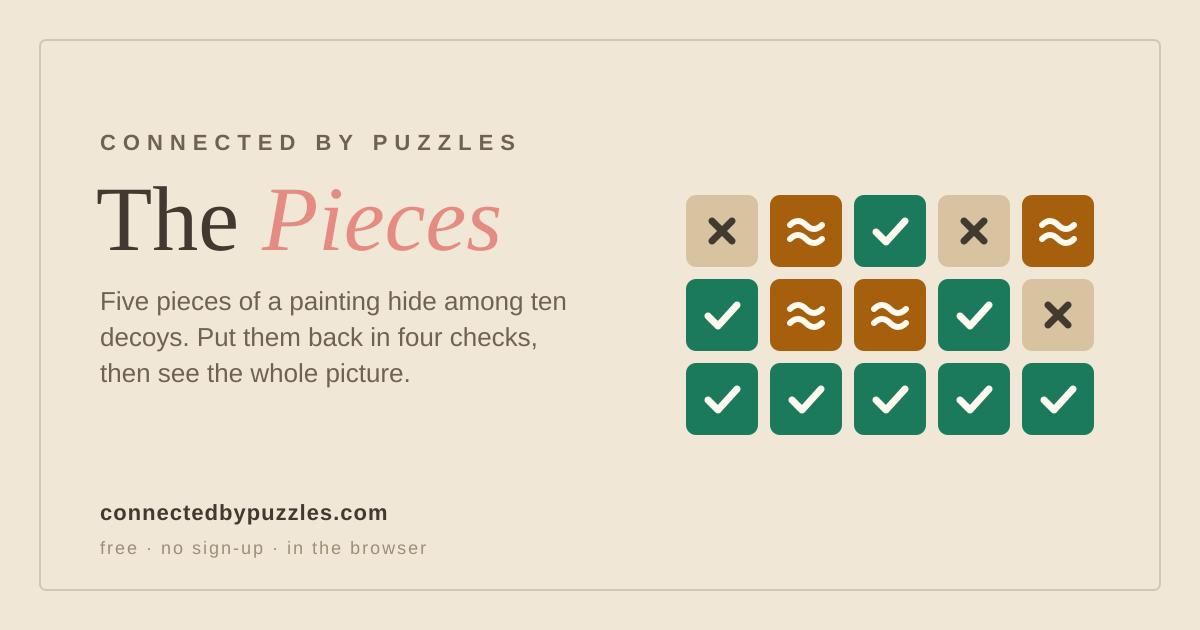
Tap a piece in the tray, then a slot. When all five slots hold a piece, check. Each slot comes back with a mark, shown as a symbol as well as a colour. A tick means the right piece is in that slot. Waves mean the piece is one of the five you are looking for, but it belongs in another slot. A cross means it is a decoy: cut from the same painting, near the slots, but not one of the five, so you can leave it in the tray from then on. Move what needs moving and check again, four times at most.
Your results stay on your device: the days you have played, your wins, your streak, your best streak, and how many checks each win took. Share the day and it goes out as rows of coloured squares, one per check, with nothing in them that gives the painting away.
What it asks of you
Half looking, half logic.
Two skills carry you through a day. The first is reading a fragment for where it sits in a picture: sky belongs near the top, ground and shadow lower down, light falls from one side, and the end of a sleeve wants the hand that comes after it. The map tells you roughly where each slot is, and the pieces tell you what was there. It is spatial reasoning, done with paintings.
The second is the marks. Waves say a piece is one of the five but belongs in another slot, and once a slot has its tick, that leaves only the slots still open. A cross rules a piece out for good. If you know the classic board game Mastermind, it is the same kind of logic, with brushwork where the coloured pegs would be.
We set the number of decoys and checks by simulating well over a thousand games before launch. A player who reads only the marks and ignores the picture solved about one day in six. One who read every piece perfectly solved most days. Across the range in between it came out at about half.
The paintings
Every one of them is also a jigsaw here.
The day’s painting is not a quiz about famous art. It comes from our own gallery: the same public-domain paintings from The Met that you can play as a jigsaw on this site at any time. So knowing a painting helps, because you already know where its sky is and which way its figures are looking. And if you go as far as learning every painting in the gallery just to do better at this, you have our utmost respect.
Questions
Before you check.
What is The Pieces?
A daily puzzle game made from a painting. Five pieces of the day’s painting hide among ten decoys, a small map shows where the five belong, and you have four checks to put them back, each one marking all five slots. When the day is done, solved or not, the whole painting appears.
Is it free?
Yes. It plays free in your browser, with no sign-up, no account and no app to download. Open the page and today’s pieces are already laid out.
When does a new puzzle come out?
At midnight UTC, every day. Everyone in the world plays the same painting, the same five slots and the same ten decoys until the next one starts.
How many guesses do I get?
Four checks in all. Each one marks all five slots at once, so a single check tells you something about every piece you placed.
What do the marks mean?
A tick means the right piece is in that slot. Waves mean the piece is one of the five you are looking for, but it belongs in another slot. A cross means it is a decoy: cut from the same painting, near the slots, but not one of the five, so you can set it aside for the day. Every mark has its own symbol as well as its colour.
Is it like Wordle?
Yes, in rhythm: one puzzle a day, the same for everyone, a handful of tries and a row of marks after each. What you read is different. Wordle hands you letters and this hands you pieces of a picture, which makes it a daily puzzle game like Wordle that uses no words at all.
Is it hard?
It is meant to come out about even. Before launch we simulated well over a thousand games. A player who read only the marks solved about one day in six, one who read every piece perfectly solved most days, and across the range in between it came out at about half. Reading the pieces is what moves you up.
Do I need to know about art?
No. Everything you need is in the pieces and the marks: where the sky sits, where the light comes from, which edge meets which. Knowing the painting helps, and every day’s painting is one you can also play as a jigsaw in our gallery.
Can I play yesterday’s puzzle?
No. There is one painting a day, and it is gone when the next one starts. If you miss a day, today’s is waiting.
Does it keep my streak?
Yes. Your days played, wins, current streak, best streak and how many checks each win took are kept in this browser on this device, along with today’s board, so a day you started stays where you left it. Clearing the site’s data clears them.
Can I share my result?
Yes. The share gives the puzzle number, your score and one row of coloured squares per check, and nothing that gives the painting away. Send it in WhatsApp or Telegram, post it on Mastodon, Bluesky, X, Facebook or Reddit, or copy it.
Can I play on my phone?
Yes. Tap a piece, then a numbered slot. On a laptop the keyboard works too. The page opens in English, French, Dutch, Spanish and Italian.
When you want company
The rest of the site seats two.
The Pieces is a short daily you play alone, the way a daily should be. Most of this site was built for two people who are not in the same room: the same painting, the same cut, one shared jigsaw table. When today’s puzzle is done and you would like to keep going with someone far away, there is a seat for them.