Pieces for cards, edges for suits
Jigsaw solitaire, in the browser.
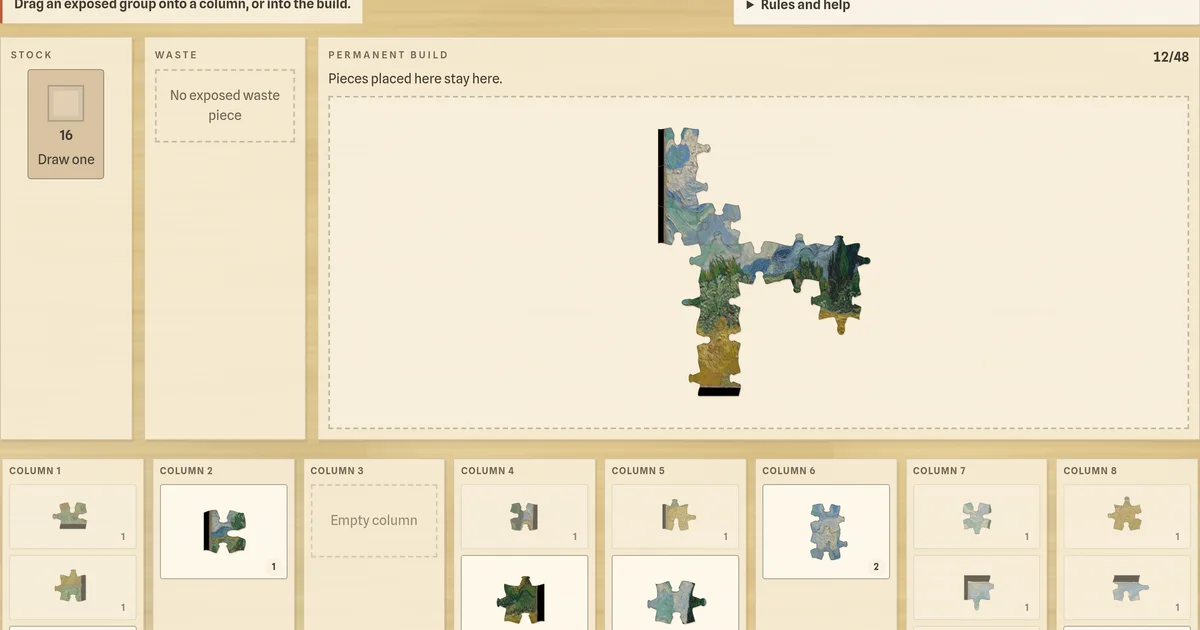
A patience game dealt from a jigsaw. Eight columns, a stock to draw from, and one permanent build where the picture comes together. Nothing matches by suit or rank here. A piece goes down beside another only where the two touch in the finished picture, so every move is a small act of looking. Free, no sign-up, and nothing to install.
free · no sign-up · plays in the browser · 40 to 100 pieces
The short version
A jigsaw puzzle, dealt like cards.
If you have played a jigsaw solitaire before, it most likely dealt square cards with slices of a photo printed on them, and you slid them into place. This one cuts a real jigsaw puzzle: tabs and blanks, a fresh seeded cut every time you deal. Two pieces go together because they were neighbours in the picture before it was cut, not because a rule permits it. The answer is in the painting rather than in the tableau.
You judge the fit
Nothing on the table marks the legal moves. You look at the piece, look at the picture, and decide. Put one where it does not belong and it will not settle: the column gives a shake and the piece comes back to you. Guessing costs a moment and nothing else.
Carry a group with you
Pick a group up and drag it where you want it. It follows your finger on a phone and your pointer on a laptop. Tap once to lift and once to put down if you prefer that, and Escape sets it back where it was.
Your picture, if you like
Play a Met painting, or upload a photo of your own and let the cut fall across it. A busy picture is gentle. A flat sky is not. That choice is your difficulty dial as much as the piece count is.
The rules
Eight columns, one stock, one build.
The shape comes from Forty Thieves, an old two-deck patience with a wide tableau and a single pass through the stock. Thirty-two pieces are dealt into eight columns, four each, and the rest wait in the stock. Only the top group in a column and the top piece of the waste can be moved. Nothing is ever dealt again.
A group lands on a column only when at least one edge of the finished picture joins it to the group already sitting there. Corner contact does not count, which catches people out early. An empty column takes anything. The build is where the picture is assembled and it is permanent: what goes in stays in, so a piece added there is a piece finished. You win when everything is in the build and the columns, stock and waste are bare.
Draw one piece at a time. Drawing again covers the last one you did not use, and the stock turns only once, so the order you spend it in matters more than it looks.
Three tables
Pick how hard you want it.
One rule separates the three: what happens when a group lands on a column that is already occupied. It decides whether columns clear or deepen, which is the whole difference between a table that opens up as you play and one that can close on you. You choose the rules and the piece count before the deal, and everything is open from the first table.
Gather
The two groups fuse into one. A column never gets deeper, so the table only opens up, and each join widens the edge you can join to next. This is the calm one. Played sensibly it comes out every time.
One at a time
Groups still fuse, but only a lone piece may land on a column. Anything you have already assembled has to go to the build or to an empty column, which makes an empty column worth keeping. It still comes out, it just asks you to think about the order.
Forty thieves
The old rule. What you put down covers what was under it. Columns deepen instead of clearing, so a piece can end up buried under one you cannot move, and the table closes. Roughly one deal in five comes out at 40 pieces, and fewer at 100. Start small here.
If you have played patience before, Gather will feel generous and Forty thieves will feel familiar. If you have not, start at Gather with sixty pieces and a painting you like the look of.
We would love you to try it, whichever table you start on. We are not going to tell you it is better than anything else out there. What we can tell you is that we have had a lot of fun playing it ourselves, rather more than we planned to while we were meant to be testing it. And to stay true to the rest of the site there are no levels, no unlocks and nothing to grind. Play it however you like.
Questions
Before you deal.
What is jigsaw solitaire?
A solitaire dealt from a jigsaw instead of a deck. The pieces are the cards, and instead of matching suit and rank you match edges: a piece or group can land on another only if the two touch in the finished picture. Corner contact does not count. You clear the table by moving everything into one connected build.
Is jigsaw solitaire free?
Yes. It plays free in your browser, there is no sign-up, and nothing is held back behind a purchase. Every painting, every piece count and all three rulesets are open from the first table.
Do I need to download an app?
No. This is a web page, so it opens on a phone, a tablet or a laptop with nothing to install and nothing to update. Close the tab whenever you like and the table will be waiting when you come back.
Is this the same as jigsaw card solitaire?
It is close, with one difference that changes the feel. Card versions deal square cards carrying slices of a photo, and you slide and swap them. Here the pieces are cut as a real jigsaw puzzle, with tabs and blanks from a seeded cut, so two pieces fit only where the cut says they fit. It plays more like assembling a puzzle and less like sliding tiles.
Which ruleset should I start with?
Gather. Groups fuse where they meet, so the table only opens up as you go, and it stays calm. One at a time is the same game with a tighter hand: only a lone piece may land on a column, so an assembled group has to go to the build or to an empty column. Forty thieves is the old, hard one.
Can you lose at jigsaw solitaire?
That depends which of the three tables you chose. On Gather and One at a time a column never grows deeper, so the table only unpacks and sensible play comes out every time. Forty thieves can be lost: what you put down covers what was under it, and a piece can end up buried under one you cannot move. If you want stakes, that is the table to pick.
What happens if I put a piece in the wrong place?
Nothing, and that is deliberate. A group that does not belong will not settle: the column gives a shake, the piece comes back to you, and the table is exactly as it was. There is no penalty and no move counter to protect, so trying one to see is a fair way to play. The one move you cannot take back is into the permanent build, which is the point of it.
How many pieces are there?
Between 40 and 100, on a slider before you deal. Thirty-two of them start in eight columns and the rest wait in the stock. Fewer pieces is much kinder on the Forty thieves table, so start low there and work up.
Can I use my own picture?
Yes. Upload a photo and the cut is made from that instead of a painting, so you can play a solitaire on a place you have been or a face you know. The picture never leaves your device. If you would rather browse, there are hundreds of public-domain paintings from The Met to choose from.
Does it save if I close the tab?
Yes. Your table is kept on your own device as you play, and it is waiting on the menu when you come back, with the time you had already spent on it. Finishing a picture clears it.
Can I play it with someone else?
Not this one. Jigsaw solitaire is yours alone, the way a patience game is. The rest of the site is built for two, though: the same paintings, the same cut, one table and two of you.
When you want company
The rest of this table seats two.
Solitaire is the one game here you play alone. Everything else on the site was built for two people who are not in the same room: the same painting, the same cut, one shared table, and voice and chat while you build. If you came for something quiet to do by yourself tonight, deal a table. If you would rather do it with someone far away, there is a seat for them.